
Chapter 1: Matter
Class 6 ICSE Concise Physics Selina
Exercise 1: Complete Questions, Answers and Explanations

Exercise 1: Objective Type Questions
Question 1: Multiple Choice Questions
Question 1(a)
The diameter of a molecule is approximately:
Show Answer and Reason
Question 1(b)
The inter-molecular forces are strongest in:
Show Answer and Reason
Question 1(c)
The molecules:
Show Answer and Reason
Question 1(d)
Solids are:
Show Answer and Reason
Question 1(e)
The inter-molecular forces in liquids are:
Show Answer and Reason
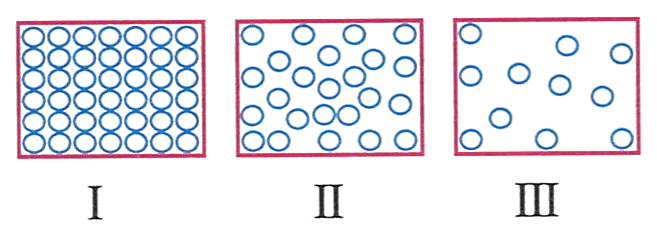
Solids: Molecules are tightly packed and inter-molecular forces are strongest. Therefore, solids have a fixed shape and volume.
Liquids: Molecules are less tightly packed, so inter-molecular forces are weaker. Liquids can flow but still have a definite volume.
Gases: Molecules are far apart and inter-molecular forces are negligible. Gases expand to fill their containers.
Question 1(f)
The diagram shows the arrangement of molecules in three states of matter. The arrangement of molecules in drinking water would look like:
Show Answer and Reason
Question 2: Fill in the Blanks
(a) All the molecules of a substance are ............... .
(b) The inter-molecular spacing is ............... in solids, ............... in liquids and ............... in gases.
(c) The molecular motion in liquid and gas is in a ............... path.
(d) In a solid, the molecules ............... but they remain at their fixed positions.
(e) The inter-molecular forces are the weakest in ............... .
(f) A solid exerts pressure ............... .
(g) Gases are ............... dense.
(h) Solids are ............... rigid.
Show Answers
(a) All the molecules of a substance are identical.
(b) The inter-molecular spacing is least in solids, more in liquids and still more in gases.
(c) The molecular motion in liquid and gas is in a zig-zag path.
(d) In a solid, the molecules vibrate on either side of their mean positions, but they remain at their fixed positions.
(e) The inter-molecular forces are the weakest in gases.
(f) A solid exerts pressure downwards on its base.
(g) Gases are least dense.
(h) Solids are most rigid.
Question 3: True or False
(a) The molecules of each substance are identical.
(b) The inter-molecular forces are effective at all distances between two molecules.
(c) The molecules in a substance are in random motion.
(d) In a gas, the molecules can move anywhere in space.
(e) Liquids are less viscous than gases.
Show Answers with Explanations
(a) False. Molecules of the same pure substance are identical, but different substances such as air and water contain different kinds of particles.
(b) False. Inter-molecular forces act effectively only over very short distances. They become negligible when molecules are far apart.
(c) True. The particles of matter are not at rest. They move randomly in different directions, often following a zig-zag path.
(d) True. Inter-molecular forces are very weak in a gas. Gas molecules are far apart and can move freely through the available space.
(e) False. Liquids are generally more viscous than gases because their molecules are closer together, producing more internal friction between layers.
Question 4: Match the Following
| Column A | Column B |
|---|---|
| (a) A molecule is composed of | (i) does not exist free in nature. |
| (b) Ice, water and water vapour | (ii) can vibrate only up to about 10−10 m from their mean positions. |
| (c) An atom | (iii) atoms. |
| (d) Gases | (iv) are the three states of water. |
| (e) The molecules of a solid | (v) occupy space. |
Show Correct Matching
| Column A | Correct Match |
|---|---|
| (a) A molecule is composed of | (iii) atoms. |
| (b) Ice, water and water vapour | (iv) are the three states of water. |
| (c) An atom | (i) does not exist free in nature. |
| (d) Gases | (v) occupy space. |
| (e) The molecules of a solid | (ii) can vibrate only up to about 10−10 m from their mean positions. |
Exercise 1: Short Answer Type
Question 1
Define matter. What is its composition?
Show Answer
Question 2
Name the three states of matter.
Show Answer
- Solid
- Liquid
- Gas
Question 3
What is a molecule?
Show Answer
Question 4
Mention one example each of a monoatomic and a diatomic molecule.
Show Answer
Monoatomic molecule: Neon, Ne
Diatomic molecule: Hydrogen, H2
Question 5
What do you mean by inter-molecular spacing?
Show Answer
Question 6
What do you mean by inter-molecular forces?
Show Answer
Question 7
What are the forces of cohesion and adhesion?
Show Answer
Force of cohesion: The force of attraction between particles of the same substance is called cohesive force.
Force of adhesion: The force of attraction between particles of two different substances is called adhesive force.
Question 8
State three characteristics of molecules of matter which determine its solid, liquid and gaseous state.
Show Answer
- Inter-molecular space
- Force of attraction between molecules
- Movement of molecules
Question 9
The molecules in a substance are in motion. What type of path do they follow?
Show Answer
Question 10
Complete the following:
(a) Solid → ............... → Liquid
(b) ............... → Boiling → Gas
Show Answer
Exercise 1: Long Answer Type
Question 1
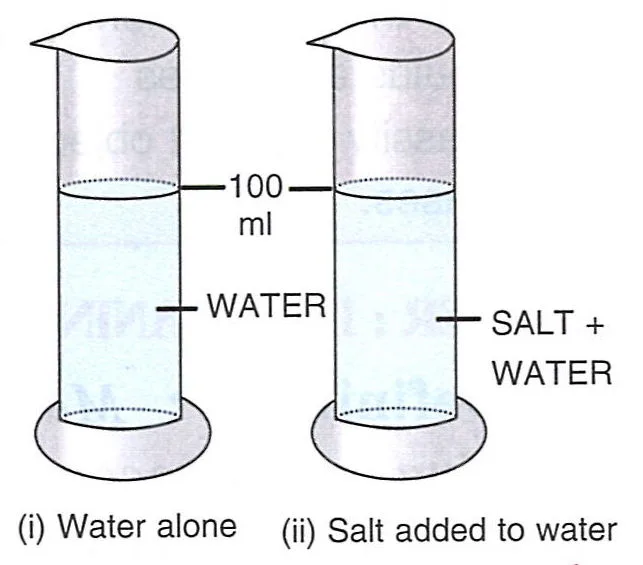
Describe a simple experiment to illustrate the existence of inter-molecular spacing.
Show Answer
Experiment:
- Take 100 ml of water in a measuring cylinder.
- Add 20 g of salt gently to the water.
- Stir well until the salt dissolves completely.
- Observe the level of water in the measuring cylinder.
The level of water does not increase significantly after the salt dissolves. This shows that the salt particles enter and occupy the spaces present between the water particles. Therefore, inter-molecular spaces exist in matter.
Question 2
How do solids, liquids and gases differ in the following properties?
(a) Size
(b) Shape
(c) Density
Show Answer
| Property | Solid | Liquid | Gas |
|---|---|---|---|
| Size or volume | Definite | Definite | Indefinite; acquires all available volume |
| Shape | Definite | Indefinite; acquires the shape of its container | Indefinite; acquires the shape of its container |
| Density | Highly dense | Less dense | Least dense |
Question 3
Describe a simple experiment to illustrate that molecules are not at rest, but constantly move.

Show Answer
- Take a beaker and fill it partly with water.
- Add a small quantity of lycopodium powder to the water.
- Stir the contents using a glass rod.
- Place a few drops of the suspension on a glass plate.
- Keep the plate on a table and illuminate it using a table lamp.
- Observe the drops through a microscope.
The fine particles of lycopodium powder are seen moving rapidly and randomly along zig-zag paths.
This happens because the water molecules are in continuous random motion. They collide with the suspended lycopodium particles from different directions and make them move irregularly.
Question 4
Write down five general properties of solids, liquids and gases.
Show Answer
| S. No. | Solid | Liquid | Gas |
|---|---|---|---|
| 1 | A solid has a definite shape and a definite size, including length, area and volume. | A liquid has a definite volume but no definite shape. | A gas has neither a definite volume nor a definite shape. |
| 2 | Molecules are closely packed. | Molecules are loosely packed compared with solids. | Molecules are very far apart. |
| 3 | Molecules remain fixed at their positions and only vibrate about their mean positions. | Molecules can move within the boundary of the liquid. | Molecules can move freely throughout the available space. |
| 4 | Inter-molecular forces are very strong. | Inter-molecular forces are moderately strong. | Inter-molecular forces are very weak. |
| 5 | Solids are highly rigid. | Liquids are less rigid. | Gases are non-rigid. |
Question 5
Give the molecular model for a solid and use it to explain why a solid has a definite volume and a definite shape.
Show Answer
- There is a strong force of attraction between the molecules of a solid.
- The molecules are closely packed with negligible inter-molecular space. Therefore, solids cannot be compressed easily.
- The orderly arrangement of molecules gives a solid a definite shape.
- The molecules vibrate on either side of their mean positions but do not leave their positions. Therefore, a solid has a definite size and volume.
- The molecules are packed tightly, so solids generally have a high density.
Thus, the molecular model explains that solids are rigid and have a definite shape, size and volume.
Question 6
Describe the molecular model for a liquid. How does it explain that a liquid has no definite shape, but has a definite volume?
Show Answer
- The molecules in a liquid are less closely packed than those in a solid because the attractive forces are weaker.
- The molecules can move over one another within the boundary of the liquid. Therefore, a liquid can flow and takes the shape of its container.
- The inter-molecular space in a liquid is greater than in a solid. Liquids are generally less dense and slightly more compressible than solids.
- The motion of liquid molecules is irregular and random, but it remains within the liquid's boundary.
- A liquid has a definite volume because its molecules remain close enough to one another and do not spread throughout all available space.
Liquids also show viscosity and surface tension because of cohesive forces between their molecules.
Question 7
A gas has neither a definite volume nor a definite shape. Describe the molecular model to explain it.

Show Answer
- Gas molecules lie much farther apart than molecules in a liquid or solid. Therefore, gases have very low density.
- The force of attraction between gas molecules is negligible, so they are free to move throughout the available space.
- Gas molecules move faster than liquid molecules. They remain in continuous random motion in all possible directions.
- Because gas molecules are far apart, a large amount of empty space is available. Therefore, gases can be compressed easily.
- Gas molecules collide with one another and with the walls of the container. Each collision can change their direction and momentum.
- A gas exerts pressure on the walls of its container because of the continuous collisions of its molecules with those walls.
Thus, a gas has neither a definite shape nor a definite volume. It can flow, spreads to fill the available space and is highly compressible.
Question 8
Distinguish between the three states of matter: solid, liquid and gas, on the basis of their molecular models.
Show Answer
| S. No. | Property | Solid | Liquid | Gas |
|---|---|---|---|---|
| 1 | Mass | Definite | Definite | Definite |
| 2 | Shape | Definite | Acquires the shape of the container | Acquires the shape of the container |
| 3 | Volume | Definite | Definite | Indefinite; occupies all available volume |
| 4 | Compressibility | Not compressible | Negligibly compressible | Highly compressible |
| 5 | Fluidity | Cannot flow | Can flow | Can flow |
| 6 | Rigidity | Highly rigid | Less rigid | Not rigid |
| 7 | Diffusion | Slow | Fast | Very fast |
| 8 | Number of free surfaces | Any number of free surfaces | Only one free surface | No free surface |
| 9 | Packing of molecules | Very closely packed | Less closely packed | Least closely packed |
| 10 | Inter-molecular forces | Strongest | Slightly weaker than in solids | Negligible |
| 11 | Expansion on heating | Low | More than solids | More than liquids |
| 12 | Motion of molecules | Only vibrate about their mean positions | Move in all directions within the boundary of the liquid | Move randomly through all available space |
| 13 | Pressure | Acts downwards at the base | Acts at all points and in all directions inside the liquid | Acts on the walls of the container |
| 14 | Viscosity | No flow viscosity | More viscous | Least viscous |
| 15 | Surface tension | Not applicable | Present due to cohesive force; the liquid tends to occupy minimum surface area | Not applicable |
Question 9
Distinguish between solids, liquids and gases on the basis of the following properties:
(a) compressibility
(b) fluidity
(c) rigidity
(d) expansion on heating
Show Answer
| Property | Solid | Liquid | Gas |
|---|---|---|---|
| Compressibility | Not compressible | Negligibly compressible | Highly compressible |
| Fluidity | Cannot flow | Can flow | Can flow |
| Rigidity | Highly rigid | Less rigid | Not rigid |
| Expansion on heating | Low | More than solids | More than liquids |
Question 10
What do you mean by change of state of matter? Explain:
(a) the change of a solid into a liquid at a constant temperature, and
(b) the change of a liquid into a gas at a constant temperature.

Show Answer
A change of state of matter is the physical transformation of a substance from one state, solid, liquid or gas, into another because of a change in temperature.
(a) Solid to liquid: Melting
The process in which a substance changes from the solid state to the liquid state by absorbing heat at a particular temperature is called melting. The particular temperature is called the melting point.
As the solid absorbs heat, the amplitude of vibration of its molecules increases. At the melting point, the molecules acquire enough energy to overcome part of the force of attraction between them. They become free to move past one another, and the solid changes into a liquid.
(b) Liquid to gas: Boiling
The process in which a substance changes from the liquid state to the gaseous state at a particular temperature is called boiling. The particular temperature is called the boiling point.
The absorbed heat increases the energy of the liquid molecules. They move more rapidly and finally overcome the attractive forces holding them in the liquid. The liquid then changes into a gas.
Question 11
Complete the crossword puzzle using the clues from this lesson.

Across
1. Matter is made up of ............... .
2. The ............... forces are less strong in liquids.
3. A solid has ............... shape.
Down
1. A solid cannot be ............... .
2. Liquids are ............... rigid.
3. Gases are ............... compressible.
Challenge
Try to solve all six clues before opening the answer panel.
Show Crossword Answers

Completed sentences:
Matter is made up of atoms.
A solid cannot be compressed.
The inter-molecular forces are less strong in liquids.
Liquids are less rigid.
A solid has a definite shape.
Gases are highly compressible.


0 Comments
Thanks, for your lovely comment!!